




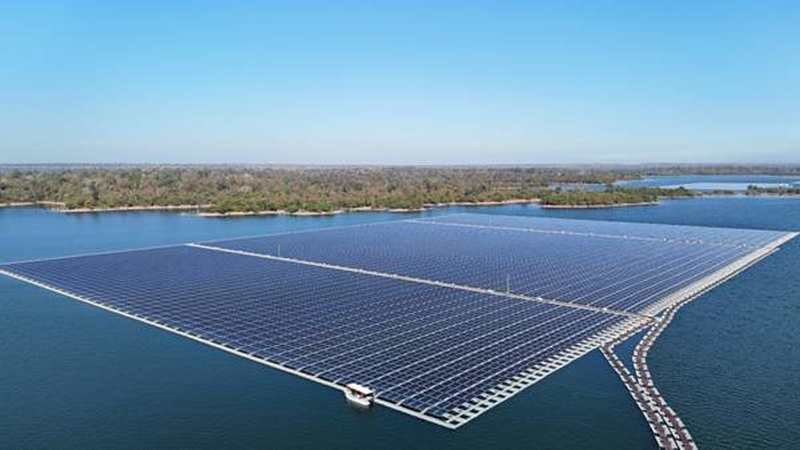
India possesses an estimated floating solar power potential of around 102 gigawatt-peak (GWp), thanks to the vast network of reservoirs, lakes, and other water bodies spread across the country.
While unveiling the report titled **”Solar PV Potential of India: Floating Solar”**, Union Minister for New and Renewable Energy, Pralhad Joshi, stated that the government is preparing a dedicated policy framework along with a deployment roadmap for floating solar projects. The report represents the first comprehensive study assessing India’s capability to install solar power systems on reservoirs and lakes.
New and Renewable Energy Secretary Santosh Kumar Sarangi highlighted that the ministry is currently consulting with the Ministry of Finance regarding incentive schemes to encourage investments in floating solar technology and agrivoltaics, both of which are expected to witness substantial growth in the coming years.
The report was developed by the National Institute of Solar Energy (NISE), an autonomous organization functioning under the Ministry of New and Renewable Energy. In a previous assessment conducted last year, NISE estimated India’s ground-mounted solar energy potential at approximately 3,343 GWp. With the inclusion of floating solar resources, the nation’s overall solar power potential has now increased to about 3,445 GWp.
At present, India has installed nearly 158 GW of solar power capacity. However, only about 600 MW of this capacity comes from floating solar projects, indicating significant room for future expansion.
According to the findings, Maharashtra leads the country with an estimated floating solar potential of 16.3 GWp, followed by Andhra Pradesh at 14.9 GWp, Karnataka at 13.7 GWp, Odisha at 12.8 GWp, and Telangana at 10.7 GWp. These states rank highest primarily due to the large number of suitable water bodies available for project development.
During the study, NISE mapped 11,197 water bodies across India. Out of these, 682 locations were identified as technically suitable for floating solar installations, covering approximately 1,946 square kilometres of reservoir surface area. The evaluation focused on water bodies having depths ranging from 3 to 30 metres and situated within 10 kilometres of both road infrastructure and transmission substations.
Although the report quantified the country’s floating solar potential, it did not provide an estimate of the total investment required to develop the full 102 GWp capacity.
Speaking at the event, Minister Joshi emphasized that reservoirs and other water resources are becoming valuable assets for clean energy generation. He noted that the ministry is actively working on a dedicated programme to support the growth of the floating solar sector. According to him, these efforts demonstrate the government’s commitment to utilizing natural resources responsibly while accelerating India’s transition towards sustainable energy.
The minister also inaugurated an online portal under the Small Hydro Power Development Scheme, stating that the platform would improve transparency, streamline implementation processes, and enhance operational efficiency.
On the same occasion, NISE and the Military Engineering Services signed a Memorandum of Understanding (MoU) aimed at expanding solar energy adoption across defence establishments. As part of the partnership, NISE will offer technical expertise and support for the planning, execution, and monitoring of renewable energy projects within the defence sector.
